
Video Visual Scene Displays (VSD) for AAC | TalkingTiles GEN6
Video visual scene displays for AAC bring communication choices into the scenes people are watching. In TalkingTiles GEN6, we call this feature Interactive Videos: familiar activities, highlighted hotspots, and spoken messages—all included in the same dedicated AAC device as picture-based communication boards and the keyboard.
For families exploring AAC for autism or other complex communication needs, this offers a way to connect words with meaningful actions. Watch together, tap a highlighted part of the scene, hear its message, and create space for a shared interaction.
Want interactive videos and everyday communication tools in one device? Explore TalkingTiles AAC with GEN6.
What is a video visual scene display (video VSD)?
A visual scene display, or VSD, uses a meaningful photograph or scene with communication hotspots placed within it. A video VSD extends that idea to moving video: playback pauses at a communication opportunity, and a hotspot provides access to a word or message related to the scene.
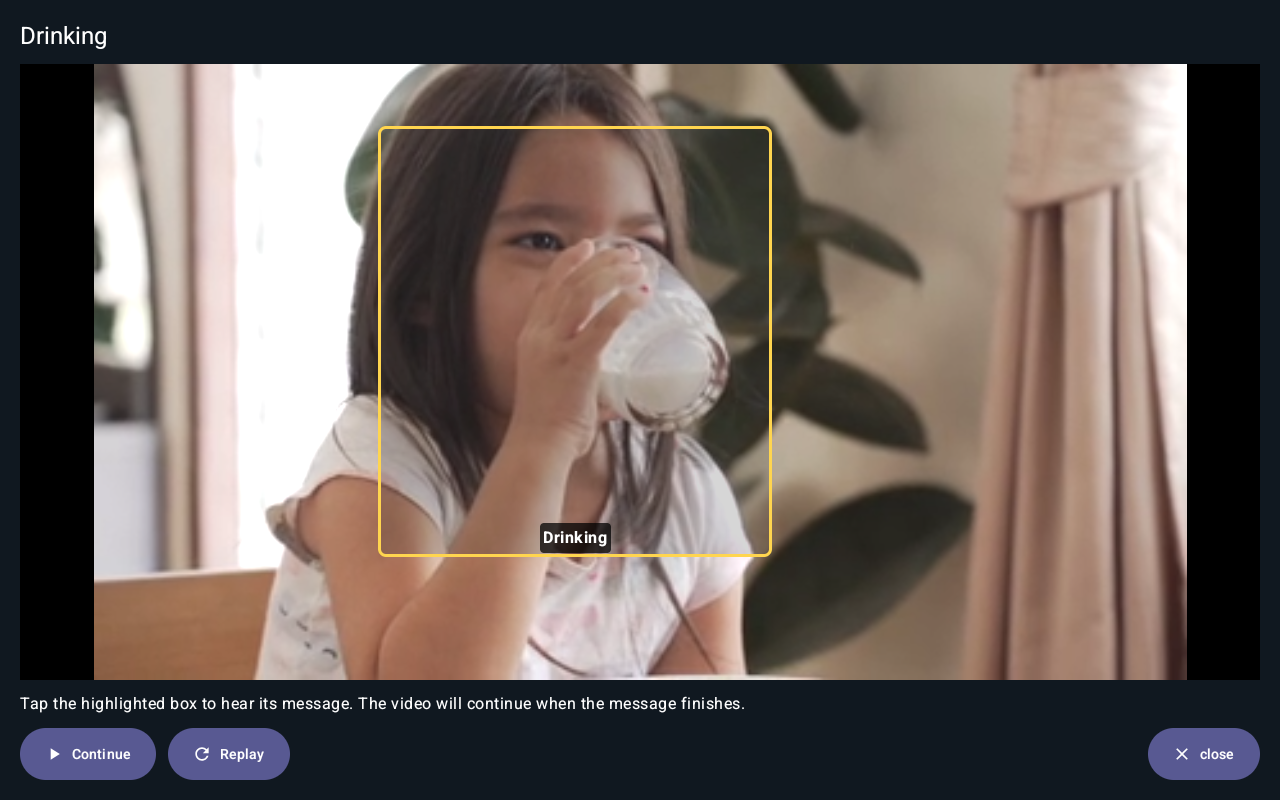
The important connection is between the message and its context. Rather than finding an unrelated symbol elsewhere, the communicator encounters a message within the activity on screen. A drinking scene, for example, can place “Drinking” directly on the action being shown.
How TalkingTiles Interactive Videos work
Open an interactive video from its tile. At an interactive moment, a highlighted box identifies the message hotspot. Tap the highlighted box to hear the message; the video continues when that message finishes. Continue and Replay controls are also available, giving you a way to move on or revisit the scene.
In the screenshot, the video is labeled “Drinking,” with a highlighted box around the person drinking. This creates a concrete opportunity to explore the action word in context. The feature can be used during a shared activity with a parent, educator, therapist, or peer.
The goal is to make space for communication: noticing an action, sharing a comment, hearing a modeled word, or taking a turn. Select scenes that interest the communicator and let their responses guide the interaction.
What research says about video VSDs for AAC and autism
Research on video visual scene displays has explored communication during shared videos and play. These studies support the approach as a promising way to embed AAC within motivating activities. They evaluated specific interventions and technologies, rather than TalkingTiles GEN6.
More opportunities for communicative turns
In a study by Chapin and colleagues, published in Assistive Technology, three preschoolers with autism and complex communication needs used video VSD technology during shared video activities. All three showed large increases in communicative turns with their partners after the intervention began. The small sample supports a promising direction, rather than a guaranteed result for every child.
Words presented within meaningful scenes
Patenaude and colleagues’ evidence-based practice synthesis reviewed visual scene displays and video VSDs with young children. It describes how hotspots make vocabulary available within meaningful activities, and how a pause in the video can provide a cue for interaction. The synthesis found evidence supporting these approaches for communication goals in early childhood settings.
Support within a shared activity
The research points toward more than simply displaying a video. Relevant vocabulary, responsive communication partners, and opportunities to participate are part of the interaction. TalkingTiles Interactive Videos reflect that design principle by putting spoken messages into the scene and providing a moment to engage.
Research supports the broader VSD approach; it does not establish that TalkingTiles produces the same outcomes, that a child will learn a particular skill, or that video VSDs are always preferable to other AAC layouts. The strongest practical use is individualized, meaningful communication.
Interactive Videos, boards, and spelling in one dedicated AAC device
TalkingTiles GEN6 includes Interactive Videos in the same dedicated AAC device as its communication boards and keyboard. Families can explore language in video scenes while retaining access to picture-based messages, spelling, and saved phrases in the same system.
That means you do not need to buy a separate VSD app or a second device to access the Interactive Videos already included in TalkingTiles GEN6. It is a concrete convenience: fewer separate tools to assemble for these features, with more ways to communicate available in one place.
As a learner’s needs and preferences change, you can explore the device’s other communication options alongside videos. Interactive Videos do not have to be a stage the child must complete before using a board or keyboard. Different methods can be used together, according to what works for the person and the situation.
Ready to bring these options together? Shop TalkingTiles AAC devices and explore GEN6.
Who might find Interactive Videos useful?
Interactive Videos may be useful for beginning communicators who enjoy shared videos, people who engage with familiar actions and routines, and communication partners looking for opportunities to model words in context. Much of the research discussed here involves young children with complex communication needs, including autism.
Interest in videos alone does not establish whether this is the right AAC approach. Consider the person’s attention, vision, hearing, motor access, and preferences. Offer the tools without pressure, observe what invites participation, and seek support from an AAC-experienced speech-language pathologist when needed.
Make an interactive video a shared communication moment
Choose a scene the communicator enjoys. Watch together, notice the highlighted hotspot, and model tapping it to hear the message. Pause your own talking and give the person time to respond through speech, gesture, AAC, or another communication mode.
For the drinking scene, you might say “Drinking,” point out what is happening, and wait. The person may choose to hear the message again, comment, or return to their communication board to request something. Follow their intent rather than expecting a single correct response.
Use Replay when revisiting the scene is welcome, and Continue when the person wants to move on. Connect the video with real experiences when it is natural to do so: a drink at snack time, a favorite play activity, or a familiar routine.
Explore the rest of TalkingTiles GEN6
Interactive Videos sit within a broader communication toolkit. Learn about AAC keyboard suggestions for spellers and older adults, scanning access with or without a switch, and the full GEN6 feature release.
Frequently asked questions about video visual scene displays
Are Interactive Videos the same idea as video VSDs?
TalkingTiles calls its feature Interactive Videos. It uses the video VSD approach of placing selectable spoken-message hotspots within meaningful video scenes.
Do I need another app or device for TalkingTiles Interactive Videos?
No additional VSD app or second device is required for the Interactive Videos included in TalkingTiles GEN6. The feature is part of the dedicated device’s communication toolkit.
Are video VSDs only for autism?
No. Visual scene displays are an AAC approach for people with complex communication needs. The autism studies cited here provide evidence for those study populations; choosing an approach should depend on the individual rather than diagnosis alone.
Will my child have to move to another device to use boards or spelling?
TalkingTiles already includes communication boards and a keyboard alongside Interactive Videos. You can explore those options on the same device as preferences and skills change. Future access or communication needs may still call for an individualized reassessment.
Does research prove TalkingTiles improves communication?
The cited research supports video VSD interventions in the studied settings. It did not evaluate TalkingTiles GEN6, so it should not be read as a product-specific clinical claim.
Research and further reading
Chapin et al.: The Effects of AAC Video Visual Scene Display Technology on the Communicative Turns of Preschoolers with Autism Spectrum Disorder. Assistive Technology, 34(5), 577–587 (2022).
Bring Interactive Videos into everyday communication
Explore TalkingTiles GEN6: Interactive Videos, communication boards, and keyboard options in one dedicated AAC device. Find a setup that makes room for your learner’s interests, choices, and voice.